La Voix de Notre-Dame
Secrets of a Manuscript
Das Repertoire der improvisierten Notre-Dame Organa im Schatten von Magister Pérotin
English translation see below
PER-SONAT
5 Sängerinnen, 2 Instrumentalist:innen (Fidel, Harfe)
Das Repertoire der improvisierten Notre-Dame Organa im Schatten von Magister Pérotin
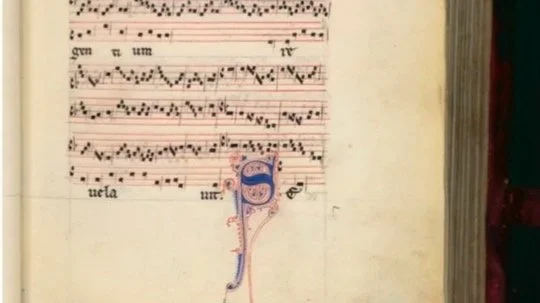
Das Programm La Voix de Notre-Dame - Secrets of a Manuscript spürt den Wurzeln der Improvisation nach, die im Schatten der Überlieferung steht. Zusammen mit dem Publikum begeben wir uns in eine ferne Klangwelt, die längst vergessen schlummert. Eine magische und mystische Parallelwelt, die zu leuchten beginnt, wenn die Musik durch das wiedergefundene Wissen neu zu existieren beginnt.
Ausgangspunkt ist das Vatikanische Organum-Traktat (VO), eine Abhandlung über polyphone Improvisation aus der Notre-Dame Zeit. Wie die Scholaren im 13. Jahrhundert lassen wir uns von den Regeln und Beispielen des Traktats anleiten, über gregorianische Melodien zu improvisieren. Diese Technik nennt man Organum-Singen und sie entstand im 12. und 13. Jahrhundert im Umkreis der Notre-Dame de Paris. Wo diese Abhandlung geschrieben wurde und wie groß ihre Verbreitung war, ist unklar. Interessanter Weise findet sich das Organum „Alleluja Hic Martinus“ aus dem Vatikanische Organum-Traktat auch im Magnus liber organi Magister Leonins. Welche Fassung nun zuerst da gewesen ist, wissen wir nicht. Vergleicht man die improvisierte Fassung mit der Komposition Leonins ist sie formelhafter. Studiert man die 31 Regeln des Traktats mit seinen 318 Notenbeispielen, 25 Zusatzbeispielen und den 3 Organum-Kompositionen wird Stil und Vorgehensweise deutlich. Die Organum-Sänger und Sängerinnen konnten auf ein großes Repertoire von musikalischen Modulen zurückgreifen und aus dem Stegreif Organa improvisieren. In dieses Spannungsfeld stellen wir die überlieferte Musik von Magister Perotinus und Leoninus und verschränken im Konzert Improvisation und Komposition miteinander.
ENGLISCHE VERSION
La Voix de Notre-Dame
Secrets of a Manuscript
Improvised Organa of the 13th century in the light of Magister Perotinus
Our concert ‘Secrets of a Manuscript – La Voix de Notre-Dame’ traces the roots of improvisation, which lies in the shadow of tradition. Together with the audience, we embark on a journey into a distant world of sound that long has been forgotten. A magical and mystical parallel world that begins to shine when the music is given new life through rediscovered knowledge.
The starting point is the ‘Vatican Organum Treatise (VO)’, a treatise on polyphonic improvisation from the Notre Dame School. Like the scholars of the 13th century, we let ourselves be guided by the rules and examples of the treatise on the improvisation of Gregorian chants. The origins of this technique called organum singing are going back to the 12th and 13th centuries in the sphere of Notre Dame de Paris. Where the treatise was written and how far its dissemination reached is unclear. Interestingly, the organum ‘Alleluja Hic Martinus’ from the Vatican Organum Treatise can also be found in Magister Leonin’s Magnus liber organi. We do not really know which version came first. Compared to Leonin’s composition, the improvised version is more formal. Studying the 31 rules of the treatise with its 318 musical examples, 25 additional examples, and 3 organum compositions, the approach and style become clear. Organum singers could draw on a large repertoire of musical modules and improvise organa impromptu. In the concert, improvisation and composition are intertwined as we place the traditional music of Magister Perotinus and Leoninus within this field of tension.
Sabine Lutzenberger